(Image Credit – Vintage Books)
In a story titled “Questions Posed by a Mad Mathematician,” Russian author Anton Chekov describes a train traveling between stations at specific times. Weaving an intricate question of Arithmetic in between the story, Chekov concludes with an abstruse question, “Who is capable of loving longer, a man or a woman?”
The metaphysical query of who can love longer weaves through the narrative of Richard Flanagan’s serrating new book, Question 7. Diaphanous yet determined and vulnerable yet resolute, Question 7 is more a call for self-introspection than a non-linear assemblage of bitter-sweet memories. Flanagan begins his book on a mellow note as he describes his visit to the infamous death mines of Ohama in Japan. A multitude of Allied Prisoners Of War were mercilessly made to work their bones off at these mines, and many of them succumbed to either the rigours of work or the rapaciousness of their Japanese captors. Flanagan’s father was one of those people fortunate to have survived the horrors of the concentration camp.
The visit to Japan seems to have triggered a “chaos theory” effect in the author. He proceeds to exquisitely thread together a series of seemingly unrelated events that led to Thomas Ferebee releasing a lever on his B-29 and letting drop an atomic bomb, paradoxically named Little Boy, which killed 60,000 – 140,000 souls in Hiroshima, on the 6th of August 1945. H.G. Wells, the undisputed pioneer of science fiction and a habitual philanderer, having experienced an unsettling encounter with Rebecca West, a trenchant and outspoken critic of his works, develops a raging obsession for West. In order to deflect his mind off West, Wells flees to the cooler climes of Switzerland and into the arms of his mistress, and a magnificent chalet. If Wells had not attempted to reign in his desire for West, he would not have written, The World Set Free, a book in which he first foresaw the creation of a destructive weapon of mass destruction. In fact, some credit Wells with using the word “atomic” in relation to a bomb for the first time.
If Wells hadn’t written The World Set Free, the eccentric but indescribably brilliant Leo Szilard wouldn’t have read it. If the brilliant theoretical physicist had not read the book, he wouldn’t have grasped the enormity of his prophecy about a nuclear chain reaction. If Szilard hadn’t grasped the enormity of Germany developing such a bomb first, he wouldn’t have coaxed, coerced, and cajoled Einstein to petition President Roosevelt. If that petition had never become exposed, Roosevelt might never have green flagged the Manhattan Project. But for the Manhattan Project, Thomas Ferebee would never have uttered the words “Bomb Away” and a great part of Hiroshima’s populace would have been spared the horrors of incineration.
Flanagan also links the systematic and calculated genocide of Tasmania’s Aboriginal people by the Empire with yet another H.G. Wells novel, The War of the Worlds. There is thus established an unfortunate yet plausible connection between the dreaded atomic bomb that put an end to World War II, during which his Tasmanian father was imprisoned and the remorseless extermination of the natives in his home state of Tasmania.
Flanagan builds up his reminiscences and reflections to arrive at a spine chilling personal Near-Death Experience that left a lasting imprint on him, and quite a few emotional scars. Trapped in a Kayak, with his legs jammed underneath, and a torrential flow of water threatening to engulf him, he struggles between life and death for hours before he is miraculously rescued by a friend, referred to only as ‘P’ in the book. While Flanagan jousts between survival and death, he experiences a moment of eerie calm and solitude. In what can only be described as an out of body experience, he serenely watches himself battling against all odds with the assistance of his friend and alternating between hope and futility.
Incapable of being strait jacketed into any genre, Question 7 alternatively revels and repeals. As Flanagan himself bewilderingly writes, “the only writing that can have any worth confounds time and stands outside of it, swims with it and flies with it and dives deep within it, seeking the answer to one insistent question: who loves longer?”
Question 7 does not provide a convincing let alone conclusive response to the query “who loves more?”. But it sure encourages its readers to never stop trying to love.
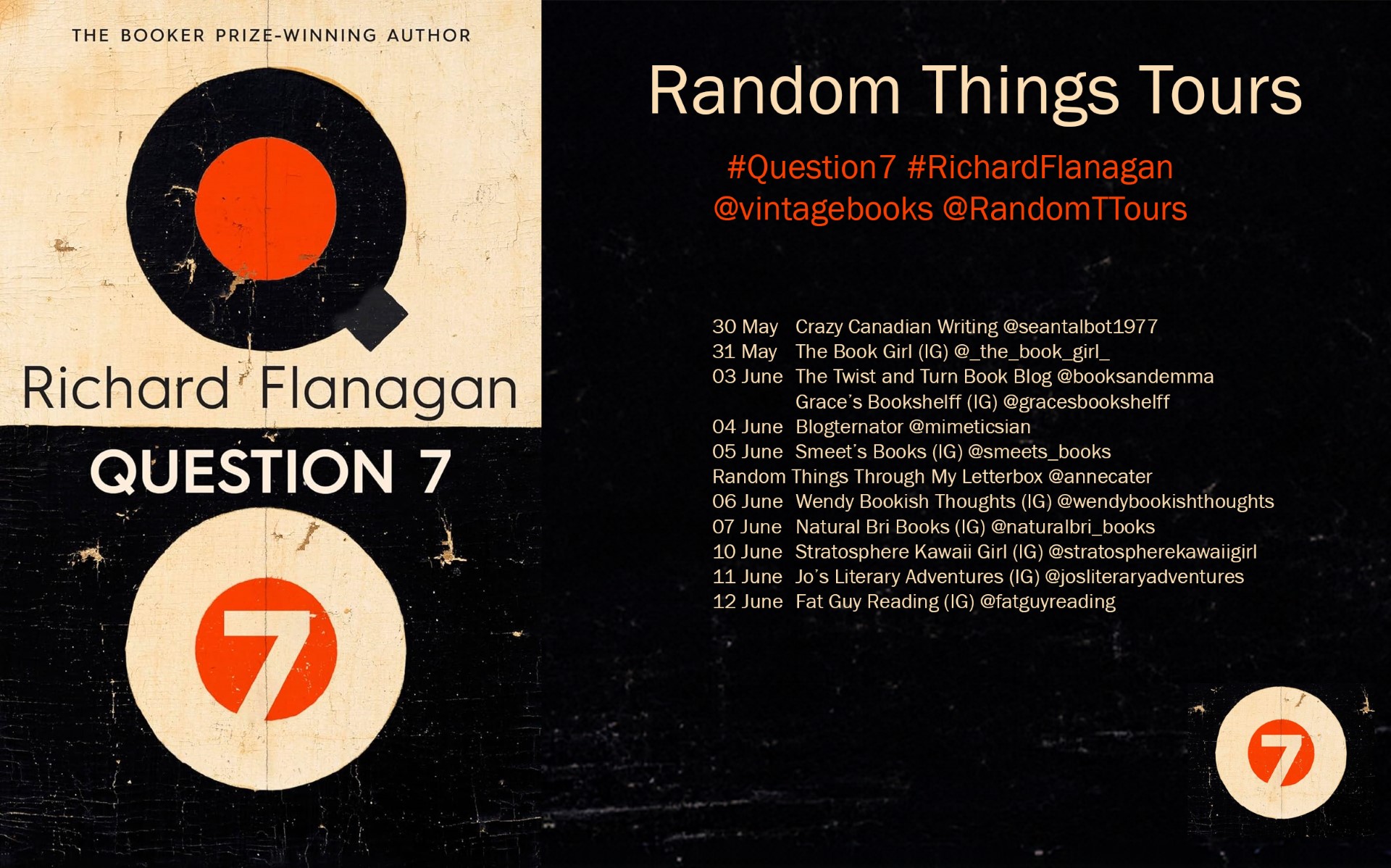
Thanks for the blog tour support x